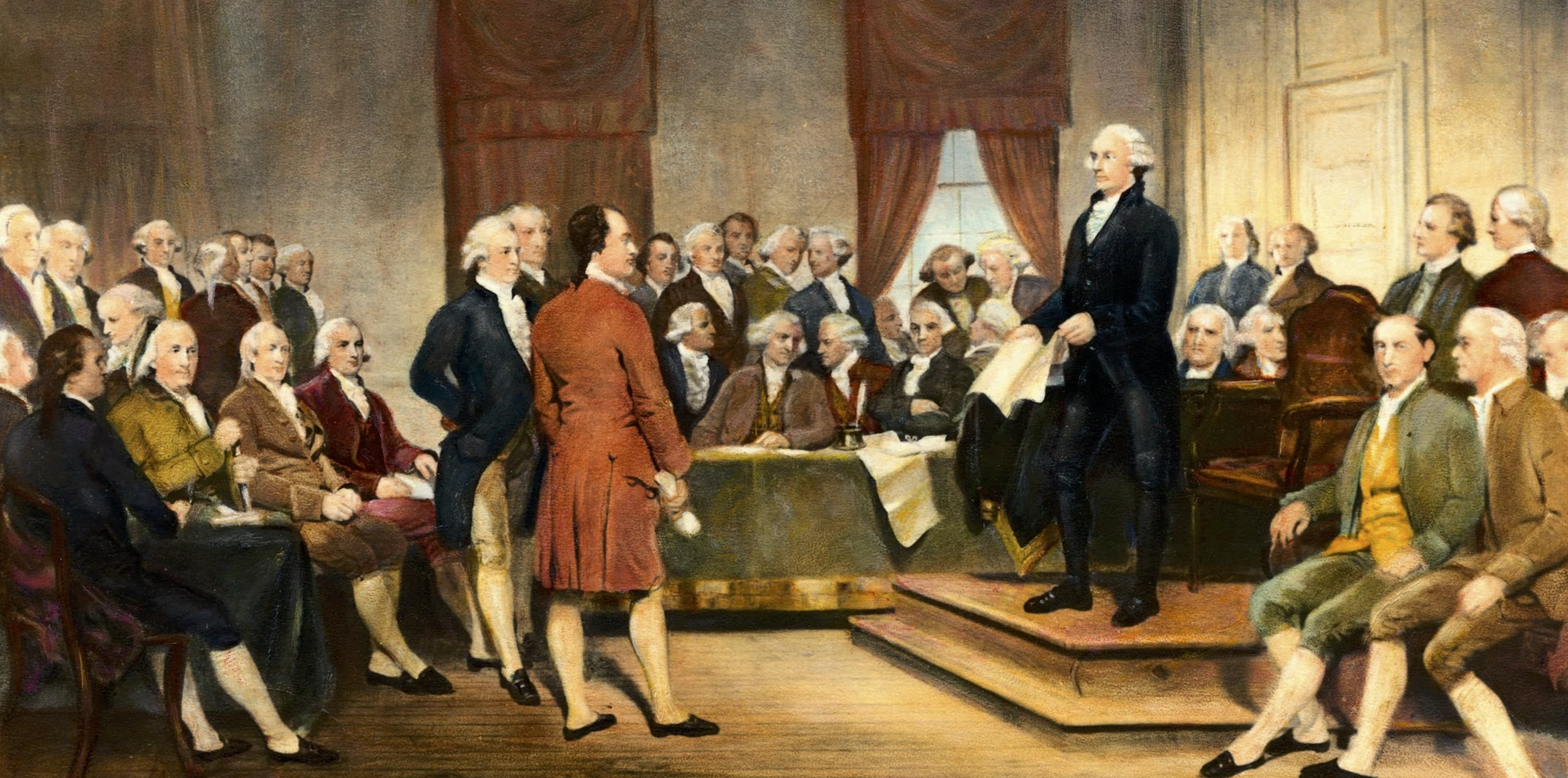
Below are select Articles of the Constitution for the United States of America broken out with notations to assist in understanding the boundaries of the government authorized by We the People and your Rights as an America secured in the Constitution as amended with the Bill of Rights in 1791. Take the time to read and familiarize yourself with the full text of the Constitution as well as the Bill of Rights as it is the Law of your Land and belongs to you.
In questions of power, let no more be heard of confidence in man, but bind him down from mischief by the chains of the Constitution.Thomas Jefferson
The Constitution is not a source of power, but a restriction on it. Jefferson’s quote above, acknowledges the weakness of man and the danger of power. He knew better than to rely on the “good intentions” of politicians and instead, bind them to the law, the Constitution, as a necessary constraint.
Keep In Mind: Unconstitutional actions are unlawful and thus, unenforceable. However, the government serves at the consent of the governed. Since it is the responsibility and duty of the American People to hold the government accountable, the failure of the American People to do so equates to consent. “Your silence is your acquiescence.” (Connally v. General Construction Co., 269 U.S. 385, 391) It is the right and duty of the American People to restore Constitutional governance when the government fails to serve We the People.
“It is time for the American people to notify their elected representatives, federal and state, that it is their mission to restore the Constitution with its proper balance among the three branches of the federal government.”
Phyllis Schlafly, “The Supremacists, The Tyranny of Judges and How to Stop It”, 2004.
Please Note: Notations to the following excerpts of the Constitution for the United States of America are indented below the original text of the document.
The Preamble
We the People of the United States, in Order to form a more perfect Union, establish Justice, insure domestic Tranquility, provide for the common defence, promote the general Welfare, and secure the Blessings of Liberty to ourselves and our Posterity, do ordain and establish this Constitution for the United States of America.
The Preamble establishes the tenor of the Constitution. It is a summary of the Constitution’s meaning in letter and spirit.
“We the People” created the Constitution. The Constitution is law made by the people for the people establishing the limited, delegated authority and boundaries of the government. The Constitution acts as the blueprint for the operations of government.
Ask yourself: Is justice established in our nation? Do we have domestic tranquility? What is the common defense? Does the Union promote the general welfare? Does the Union secure the blessings of liberty?
If you answered “No” to any of those questions, then the government defined by the Constitution and your Rights, some of which are secured in the Constitution, are not being upheld. It is the responsibility and duty of the American People rise to the occasion and repudiate government overreach.
Article I, Section 1
All legislative Powers herein granted shall be vested in a Congress of the United States, which shall consist of a Senate and House of Representatives.
The power of the legislature is vested in Congress. All new laws must be compliant with the Constitution and the Bill of Rights. As Constitution cannot conflict with itself, laws and amendments must be made pursuant to the original Constitution and the Bill of Rights. Any and all laws in conflict with the Constitution, including but not limited to unconstitutional Amendments, are unconstitutional and thus, unenforceable.
Since only Congress can make laws, Executive Orders and mandates are unconstitutional. The President/governor/any government official has no lawful authority to issue Executive Orders and mandate the American People.
Since only Congress can make laws, agencies that legislate are unconstitutional. These agencies are unlawfully assuming power they do not have and then enforcing that power upon the people.
Article I, Section 8, Clauses 1 through 17
Article 1, Section 8 Clauses clearly define the authority of the government. Government does not have “power” or rights, rather limited delegated authority granted by We the People.
The Congress shall have Power To lay and collect Taxes, Duties, Imposts and Excises, to pay the Debts and provide for the common Defence and general Welfare of the United States; but all Duties, Imposts and Excises shall be uniform throughout the United States;
To borrow Money on the credit of the United States;
To regulate Commerce with foreign Nations, and among the several States, and with the Indian Tribes;
To establish an uniform Rule of Naturalization, and uniform Laws on the subject of Bankruptcies throughout the United States;
The Constitution is explicit that “Rules of Naturalization” must be uniform and made pursuant to the Constitution, itself.
To coin Money, regulate the Value thereof, and of foreign Coin, and fix the Standard of Weights and Measures;
To provide for the Punishment of counterfeiting the Securities and current Coin of the United States;
To establish Post Offices and post Roads;
To promote the Progress of Science and useful Arts, by securing for limited Times to Authors and Inventors the exclusive Right to their respective Writings and Discoveries;
To constitute Tribunals inferior to the supreme Court;
To define and punish Piracies and Felonies committed on the high Seas, and Offences against the Law of Nations;
To declare War, grant Letters of Marque and Reprisal, and make Rules concerning Captures on Land and Water;
To raise and support Armies, but no Appropriation of Money to that Use shall be for a longer Term than two Years;
To provide and maintain a Navy;
To make Rules for the Government and Regulation of the land and naval Forces;
Rules for the government not rules for the American People. “Article 1 Section 8 clause 14 says clearly the government makes the rules for the government not the people.” (Cruden v. Neale, 2 N.C. 338(1796)2 S.E.)
To provide for calling forth the Militia to execute the Laws of the Union, suppress Insurrections and repel Invasions;
The Militia was intended as a force derived from We the People to ensure the Laws of the Union, the Constitution, are upheld.
Suppression of insurrections means lawful response to any and all violations to the Supreme Law, the Constitution.
To provide for organizing, arming, and disciplining, the Militia, and for governing such Part of them as may be employed in the Service of the United States, reserving to the States respectively, the Appointment of the Officers, and the Authority of training the Militia according to the discipline prescribed by Congress;
To exercise exclusive Legislation in all Cases whatsoever, over such District (not exceeding ten Miles square) as may, by Cession of particular States, and the Acceptance of Congress, become the Seat of Government of the United States, and to exercise like Authority over all Places purchased by the Consent of the Legislature of the State in which the Same shall be, for the Erection of Forts, Magazines, Arsenals, dock-Yards, and other needful Buildings;–And
To make all Laws which shall be necessary and proper for carrying into Execution the foregoing Powers, and all other Powers vested by this Constitution in the Government of the United States, or in any Department or Officer thereof.
Article I, Section 9
The Migration or Importation of such Persons as any of the States now existing shall think proper to admit, shall not be prohibited by the Congress prior to the Year one thousand eight hundred and eight, but a Tax or duty may be imposed on such Importation, not exceeding ten dollars for each Person.
The Constitution is explicit that the States may establish Constitutionally compliant immigration law.
If borders are not lawfully defined, immigration is not defined and the government fails to provide for the common defense against foreign invasion into the country.
The Privilege of the Writ of Habeas Corpus shall not be suspended, unless when in Cases of Rebellion or Invasion the public Safety may require it.
Habeas Corpus, Latin for “you shall have the body”. If the government fails to physically bring a prisoner before a judge to justify the detention, Habeas Corpus is violated. If the government cannot prove the detention is lawful, the prisoner must be released.
No Bill of Attainder or ex post facto Law shall be passed.
A bill of attainder is unlawful procedure/legislation that declares man, woman, or group guilty of misconduct or a crime and imposes punishment void of a judicial proceeding violating due process of law (national Constitution Amendment 5).
An “ex post facto law” Latin for “from a thing done afterward” is an unlawful law that changes the legal consequences of actions committed before its enactment, generally by criminalizing conduct, increasing punishment, or altering evidence rules to make conviction easier.
No Capitation, or other direct, Tax shall be laid, unless in Proportion to the Census or enumeration herein before directed to be taken.
Prohibits direct taxes upon the American Citizens.
No Tax or Duty shall be laid on Articles exported from any State.
No Preference shall be given by any Regulation of Commerce or Revenue to the Ports of one State over those of another: nor shall Vessels bound to, or from, one State, be obliged to enter, clear, or pay Duties in another.
No Money shall be drawn from the Treasury, but in Consequence of Appropriations made by Law; and a regular Statement and Account of the Receipts and Expenditures of all public Money shall be published from time to time.
Monies cannot be taken out of the Treasury without first being approved according to Constitutionally compliant law.
No Title of Nobility shall be granted by the United States: And no Person holding any Office of Profit or Trust under them, shall, without the Consent of the Congress, accept of any present, Emolument, Office, or Title, of any kind whatever, from any King, Prince, or foreign State.
Article I, Section 10
No State shall enter into any Treaty, Alliance, or Confederation; grant Letters of Marque and Reprisal; coin Money; emit Bills of Credit; make any Thing but gold and silver Coin a Tender in Payment of Debts; pass any Bill of Attainder, ex post facto Law, or Law impairing the Obligation of Contracts, or grant any Title of Nobility.
The Constitution clarifies actions prohibited to the Federal government which are also prohibited to the States.
Federal and State governments cannot lawfully impair the Obligation of Contracts meaning that the government can neither impose a contract on an American Citizen nor entangle itself in the private contracts of American Citizens.
No one can force you into a contract. If they do, it’s not a contract. For a contract to be valid, all parties must be consulted pursuant to due process of law, equal protection under the law, and full disclosure. Failure to do so, is fraud by omission, rendering the contract null and void.
No State shall, without the Consent of the Congress, lay any Imposts or Duties on Imports or Exports, except what may be absolutely necessary for executing it’s inspection Laws: and the net Produce of all Duties and Imposts, laid by any State on Imports or Exports, shall be for the Use of the Treasury of the United States; and all such Laws shall be subject to the Revision and Control of the Congress.
No State shall, without the Consent of Congress, lay any Duty of Tonnage, keep Troops, or Ships of War in time of Peace, enter into any Agreement or Compact with another State, or with a foreign Power, or engage in War, unless actually invaded, or in such imminent Danger as will not admit of delay.
Article IV Section 1
Full Faith and Credit shall be given in each State to the public Acts, Records, and judicial Proceedings of every other State. And the Congress may by general Laws prescribe the Manner in which such Acts, Records and Proceedings shall be proved, and the Effect thereof.
The Constitution is the Supreme Law of the Land. The lawful judicial proceedings that take place in one State are binding upon all States.
Article IV, Section 2, Clause 1
The Citizens of each State shall be entitled to all Privileges and Immunities of Citizens in the several States.
The Constitution is the Supreme Law of the Land. Rights, privileges, and immunities guaranteed in one State are guaranteed in all States.
Article IV, Section 4
The United States shall guarantee to every State in this Union a Republican Form of Government, and shall protect each of them against Invasion; and on Application of the Legislature, or of the Executive (when the Legislature cannot be convened) against domestic Violence.
America is a Constitutional Republic. A Republican Form of Government means that America is governed by a written set of laws not the whim of man. That set of laws is the national Constitution which is the supreme Law of this Land superseding and superior to any other lesser law, including federal and state statutes, codes, regulations, rules, and policies pursuant to Article VI Clauses 2 and 3.
Article VI, Clause 2
This Constitution, and the laws of the United States which shall be made in pursuance thereof; and all treaties made, or which shall be made, under the authority of the United States, shall be the supreme law of the land; and the judges in every state shall be bound thereby, anything in the Constitution or laws of any State to the contrary notwithstanding.
The Constitution is the Supreme Law of the Land. All laws and treaties, federal, state, or other must be made in accordance with the Constitution. Any and all laws or treaties in conflict with the Constitution are unlawful thus unenforceable.
Keep In Mind: Unconstitutional actions are unlawful and thus, unenforceable. However, the government serves at the consent of the governed. Since it is the responsibility and duty of the American People to hold the government accountable, the failure of the American People to do so equates to consent. “Your silence is your acquiescence.” (Connally v. General Construction Co., 269 U.S. 385, 391) It is the right and duty of the American People to restore Constitutional governance when the government fails to serve We the People.
Article VI, Clause 3
The Senators and Representatives before mentioned, and the members of the several state legislatures, and all executive and judicial officers, both of the United States and of the several states, shall be bound by oath or affirmation, to support this Constitution; but no religious test shall ever be required as a qualification to any office or public trust under the United States.
All government officials are bound by oath to support and defend the Constitution. Pursuant to the 9th Amendment, all American Citizens expect their public officers to abide by their oaths in the performance of their official duties as Constitutionally mandated. Any action of a public official against the Constitution renders them unfit to hold public office, 14th Amendment, Sections 3 & 4.
Read the Full text of the Constitution here.
Read The Bill of Rights here.